Road-tripping Morocco in autumn: why it's the best season to drive
Between late September and late November, Morocco becomes drivable again where summer made it exhausting: the desert drops back under the bearable line, the High Atlas returns to its hiking season, and the roads empty out from the July-August crowds. Specialist travel guides consistently rank autumn, alongside spring, as the best window to cross the country by car. Here's why — and how to plan the trip across the 10 cities Loccor covers.
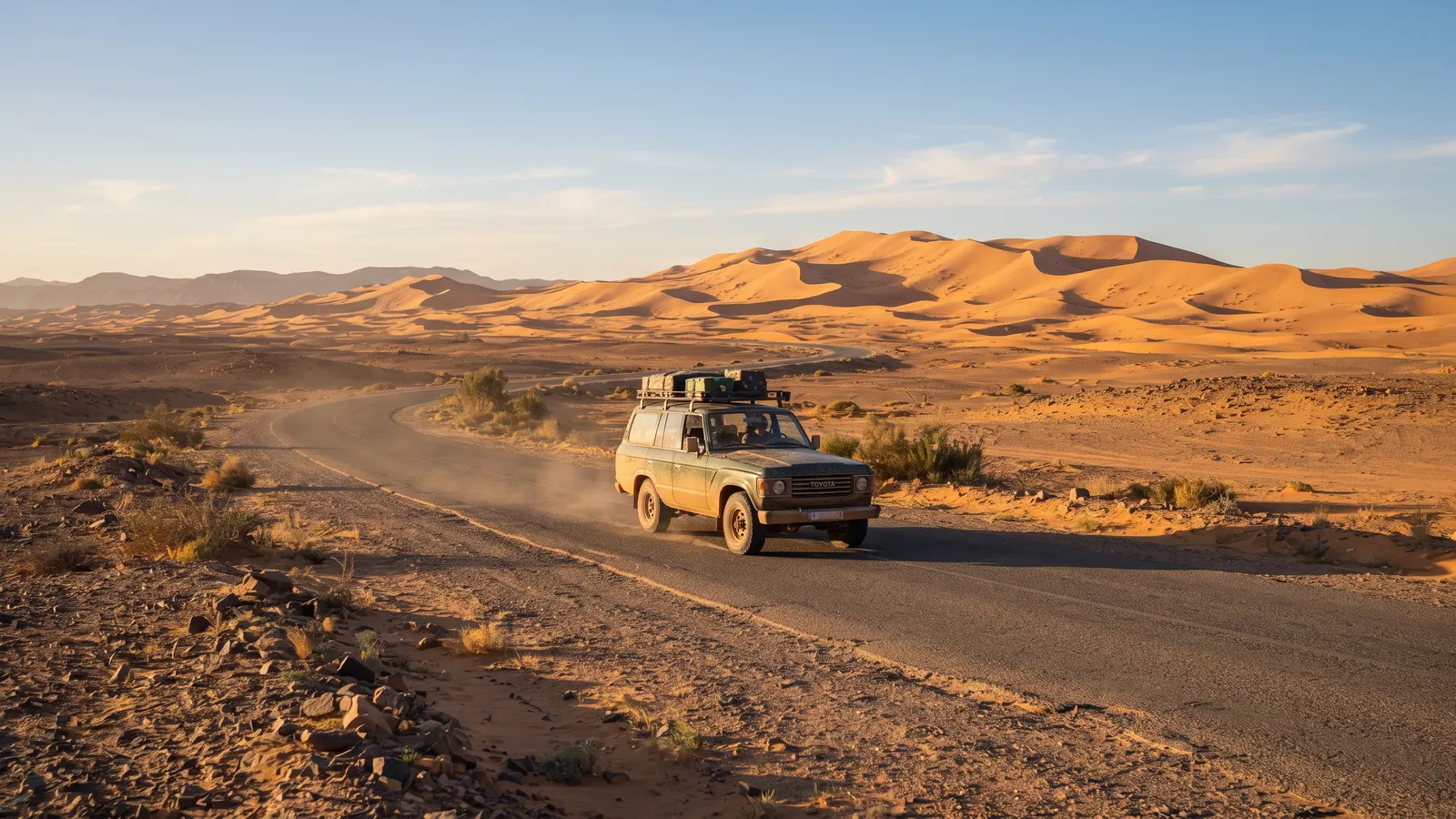
Photo: Image generee par IA (Google Gemini) — Generation IA — non soumise a une licence Commons (Wikimedia Commons)
Published on 2026-09-25
Contents
- Best time to visit Morocco: why autumn is the recommended season
- The Sahara becomes drivable again from October
- The High Atlas returns to its real trekking season
- Fewer crowds, more comfortable driving
- Planning a self-drive itinerary in autumn with Loccor
Best time to visit Morocco: why autumn is the recommended season
Specialist travel guides agree: spring (March-May) and autumn (September-November) are the two recommended windows for visiting Morocco, as opposed to summer, considered too hot for comfortable long-distance driving. Lonely Planet goes further and names September as 'probably the best month for good weather and fewer crowds', once summer travellers have gone home.
A French climate guide similarly places April-May and September-October as the country's most pleasant months, climate-wise. It isn't a matter of taste: it's the gap between crushing heat across the desert and plains in high summer, and temperatures that become manageable again without dropping into the cold of the mountain winter.
The Sahara becomes drivable again from October
In summer, southern Morocco commonly climbs to 45°C during the day, sometimes past 50°C around Merzouga, Zagora or the Erg Chebbi dunes — several specialist guides explicitly advise against desert tours during this period. Long drives, tent camping, or even a simple stopover become exhausting, sometimes risky: dehydration, vehicle overheating.
From October, that changes: Lonely Planet notes that travellers can then 'get around the Moroccan Sahara comfortably'. In Zagora, the desert's gateway town, seasonal averages drop from around 44°C in summer to far more manageable figures as winter approaches — autumn is exactly that transition. Days stay warm, nights cool down sharply, which is what makes tent camping appealing again.
Our guide to road-tripping southern Morocco and the desert covers the stages; it's typically driven from Marrakech, a Loccor-covered city and the classic starting point toward Merzouga and Zagora.
The High Atlas returns to its real trekking season
Unlike the desert or the coast, the High Atlas runs on its own calendar: too hot for long summer hikes, then covered in frost as winter sets in — down to -18°C at altitude according to the country's climate records. In between, September to November brings daytime temperatures of 15-25°C, the window consistently recommended by trekking guides for hiking or a Toubkal ascent, alongside spring.
The trailhead villages — Imlil, the Ourika valley — are reachable by car from Marrakech, making it possible to combine a mountain stage with the rest of a wider circuit toward the desert or the coast.
Fewer crowds, more comfortable driving
Beyond the weather, autumn also marks the retreat of the July-August crowds: Lonely Planet explicitly cites lower visitor numbers as a point in September's favour. Less traffic on the main tourist routes, shorter waits in the medinas, and less strain on the air conditioning over long drives — autumn cuts the driving fatigue that comes with summer's heat.
The timing also overlaps with a good share of Europe's autumn school holidays: France's Toussaint break (17 October-2 November 2026), Belgium's autumn holiday in the French-speaking Fédération Wallonie-Bruxelles (19-30 October, plus 2 November) and in Flanders (2-8 November), the Dutch herfstvakantie (roughly 10-25 October depending on the region), and Germany's Herbstferien, which vary by state but cluster most widely around 19-23 October. That overlap is exactly why travel forums — British as much as French or Dutch — keep asking the same question: how to plan a roughly ten-day Morocco road trip within this window, and whether the heat still works with kids in tow.
Planning a self-drive itinerary in autumn with Loccor
Loccor covers 10 Moroccan cities — Casablanca, Marrakech, Tangier, Agadir, Rabat, Fez, Tetouan, Al Hoceima, Nador and Essaouira — enough to build an itinerary combining several of the regions above: the desert and Atlas from Marrakech, the Atlantic coast from Essaouira or Agadir, the north and the Rif from Tangier or Tetouan.
Across the Loccor catalogue, mileage is unlimited on 394 of the 402 cars currently listed — still worth checking on each car's own page before booking a long itinerary, since some agencies cap it. For stays of several weeks, tiered long-stay pricing from 7, 15 or 30 days can also change the maths.
Compare available cars for your dates on the Loccor search, city by city.
Frequently asked questions
Is September too hot to visit Morocco?
No — it's actually one of the periods travel guides recommend, alongside spring, as opposed to summer. The desert stays warm during the day but becomes manageable again, and the Atlas returns to hiking temperatures around 15-25°C.
Is it better to go in September or October?
Both months are recommended. Lonely Planet names September as a sweet spot for weather and crowds; October is when the Sahara becomes comfortable to drive again, per the same guide. The choice mostly depends on your itinerary: the desert leans toward October-November, the rest of the country works from September.
Can you drive the Sahara desert in a rental car during autumn?
Yes — it's actually the recommended season: summer's 45-50°C, which makes long-distance driving and tent camping risky, drops significantly from October. Our guide to road-tripping southern Morocco covers the route from Marrakech.
Which cities does Loccor cover for an autumn road trip?
Ten: Casablanca, Marrakech, Tangier, Agadir, Rabat, Fez, Tetouan, Al Hoceima, Nador and Essaouira — enough to combine desert, Atlas, Atlantic coast and the north depending on your route.
Is Morocco in October too hot to visit with kids?
It's a common worry on travel forums, but no: October is exactly when temperatures turn manageable again after summer. The desert still runs hot by day, cooled by chilly nights, while the coastal cities and the Atlas stay mild. That's part of why the window overlaps so many family school holidays across Europe.
Further reading
road-tripping southern Morocco and the desert
monthly car rental for a longer stay
understand deposits and bank cards
the complete guide to a Morocco road trip
the calendar of autumn events in Morocco
Written by the Loccor editorial team, the platform connecting travellers with car rental agencies in Morocco.
Browse the cars available to rent in Morocco
More articles from the guide
Visiting Rabat by Rental Car: the Oudayas, Hassan Tower, Salé and the Beaches
Visiting Tetouan by Rental Car: the Medina, the Tamuda Bay Coast and the Rif Road
Visiting Al Hoceima by Rental Car: National Park, Coves and Rif Roads
Visiting Essaouira by Rental Car: Medina, Beaches and the Trade-Wind Coast
Monthly car rental in Morocco: long-stay prices and what to check