Driving in Morocco for the First Time: Road Conditions, Rules & Reassuring Advice
The first time you drive in a country you don't know, you feel a little apprehensive. In Morocco, the main roads are in good shape and motorways link most of the cities travellers visit. What takes some getting used to lies elsewhere: roundabouts, gendarmerie checkpoints, mountain roads. Here is what to know before you set off.
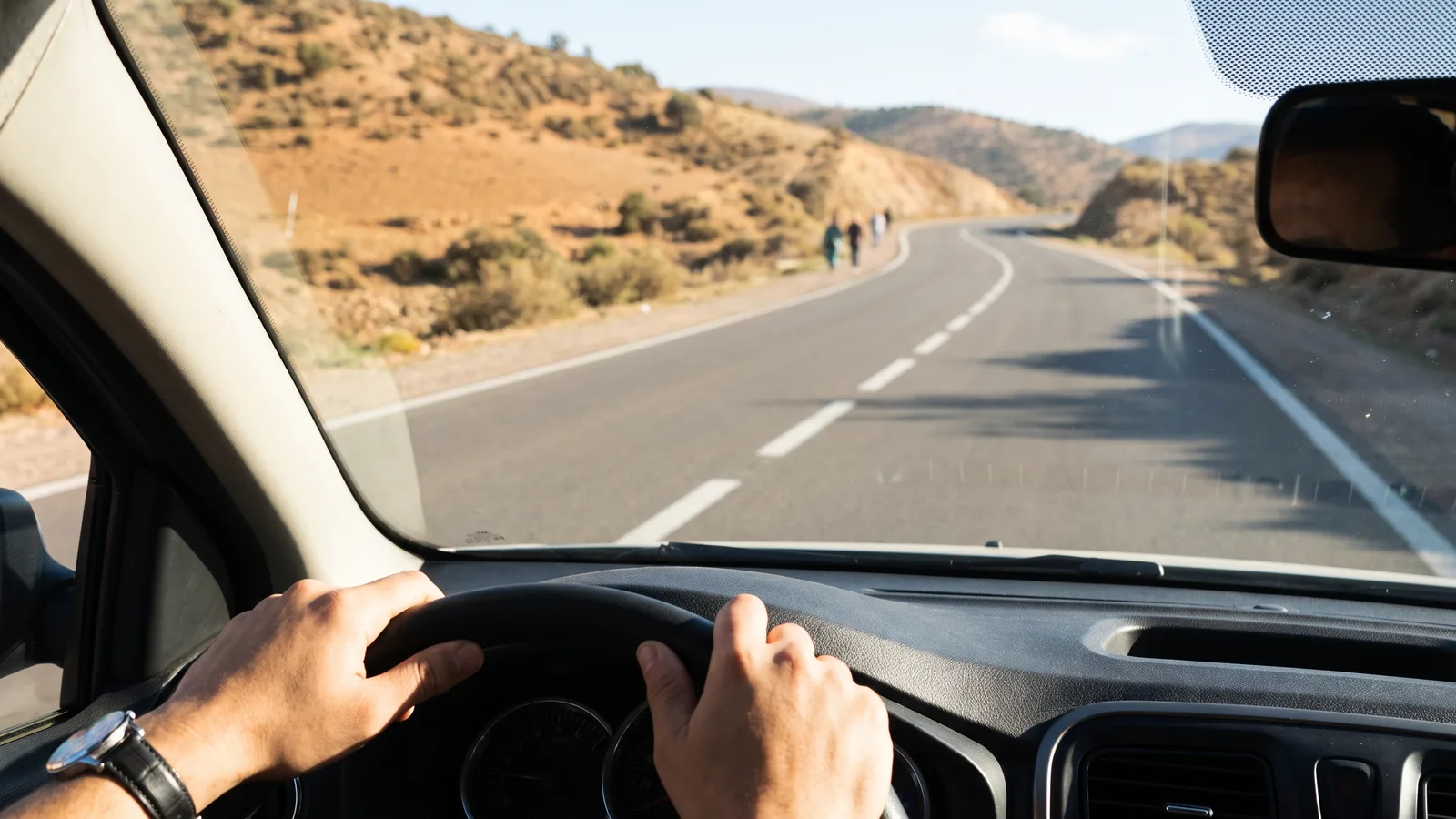
AI-generated illustration (Google Gemini)
Published on 26 September 2026
Contents
- The reality of Moroccan roads: far better than expected
- Traffic rules, roundabouts and right of way
- Speed limits, radars and Gendarmerie checkpoints
- Driving smoothly through the Atlas and Rif mountains
Rent a car in Marrakech
Compare cars from verified local agencies, then book online.
Browse the cars available to rent in Marrakech
The reality of Moroccan roads: far better than expected
The motorway network, run by Autoroutes du Maroc (ADM), links Tangier, Rabat, Casablanca, Marrakech and Agadir, Meknes, Fez and Oujda, plus El Jadida and Safi on the coast. These are dual-carriageway toll roads, well maintained, with service areas along the way.
Off the motorway, the national roads heading south have changed a lot. The N9, which links Marrakech to Ouarzazate over the Tizi n'Tichka pass, has been widened along long stretches. It is still a mountain road, with hairpins and lorries, but an ordinary small car or saloon gets over it without trouble.
Traffic rules, roundabouts and right of way
In Morocco you drive on the right, and road signs look much like Europe's, often written in Arabic and French. What surprises foreign drivers most is the roundabouts.
It all depends on the sign at the entrance. If there is a give-way sign before the ring, as on most recent roundabouts, vehicles already on it have priority. Without that sign, priority to the right applies: cars coming in go before those already going round. Read the signs at every roundabout, and follow the officer's hand signals when one is standing in the middle.
Speed limits, radars and Gendarmerie checkpoints
Unless signs say otherwise, the limit is 60 km/h in built-up areas, 100 km/h on open roads and 120 km/h on motorways. It often drops on the approach to villages and on mountain bends: follow the signs rather than habit.
Fixed speed cameras and gendarmerie checks are common, especially on the way into towns. At checkpoints, a “Halte” sign announces the stop: slow down, pull up level with the officer and wait for the signal before moving off. Keep your licence, passport and the car's papers within reach.
Driving smoothly through the Atlas and Rif mountains
The Atlas passes are among the highlights of the trip. On long descents, use engine braking so the brakes don't overheat, keep your distance behind slow lorries and never overtake without a clear view far ahead.
If an impatient driver sits on your bumper, pull over to the right as soon as there is room and let them by: you will drive more calmly afterwards.
Frequently asked questions
Do Google Maps and Waze work reliably in Morocco?
Yes. Google Maps and Waze cover Morocco well and show traffic jams in town. Download the offline map of your region before you go: mobile coverage can drop out in gorges and in the mountains.
Should I avoid driving at night on rural secondary roads?
Yes, as far as you can. Motorways are fine at night, but secondary roads are rarely lit and you meet pedestrians, mopeds without lights and animals. Plan your stages so you arrive before dark.
How do you handle an on-the-spot speeding fine in Morocco?
The amount depends on how far over the limit you were, and large excesses also bring a licence suspension. At a roadside check, the fine is settled on the spot against an official receipt: ask for it and keep it.
Further reading
our complete guide to speed cameras and fines in Morocco
motorway tolls and how to use the Jawaz pass
rent a car in Marrakech to explore the Atlas
safety tips for driving at night in Morocco
car or train in Morocco: which to choose
Sources
France Diplomatie — diplomatie.gouv.fr
The Smart Choice in Morocco
Ready to Hit the Road in Morocco with Total Freedom?
Written by the Loccor editorial team, the platform connecting travellers with car rental agencies in Morocco.
Browse the cars available to rent in Marrakech
Cars available to rent in Marrakech
- Kia Picanto 2025
- · Dacia Sandero 2025
- · Hyundai i10 2025
- · Geely GX3 2025
- · Renault Clio 2026
- · Peugeot 208 2026
- · Dacia Logan 2025
- · Opel Corsa 2026
- · Geely GX3 Pro 2025
- · MG MG3 2025
- · Dacia Sandero Stepway 2025
- · Hyundai Accent 2026
More articles from the guide
Morocco Etiquette & Travel Customs: Do's, Don'ts and Local Living Habits
Tourist Scams & Common Pitfalls in Morocco: How to Spot Red Flags and Travel Confidently
Do You Need a 4x4 or a Small Car in Morocco? Choosing the Right Vehicle for Your Itinerary
Solo Female Road Trip in Morocco: Safety and Driving Advice
GPS and Road Navigation in Morocco: Offline Maps, Waze and a Local SIM
10-Day Morocco Road Trip Itinerary: A Self-Drive Loop from Marrakech